In this article
“I have ten hours free” hides the most important part: which ten hours? A useful availability window has a beginning you can honor and an end you can protect.
Start with the edges, not the shift
Choose an earliest departure time and a latest return time. These are personal planning boundaries. The first can reflect when another commitment ends; the second can reflect when another commitment begins. Neither implies that all of the time between them ought to be used.
Use the same reference point for both. A departure from home and a return to home form one coherent interval. A departure from one place and a return to another can also work, but they need different travel assumptions. The calculator here deliberately asks only for durations; it cannot establish a route or judge whether the reference points make sense.
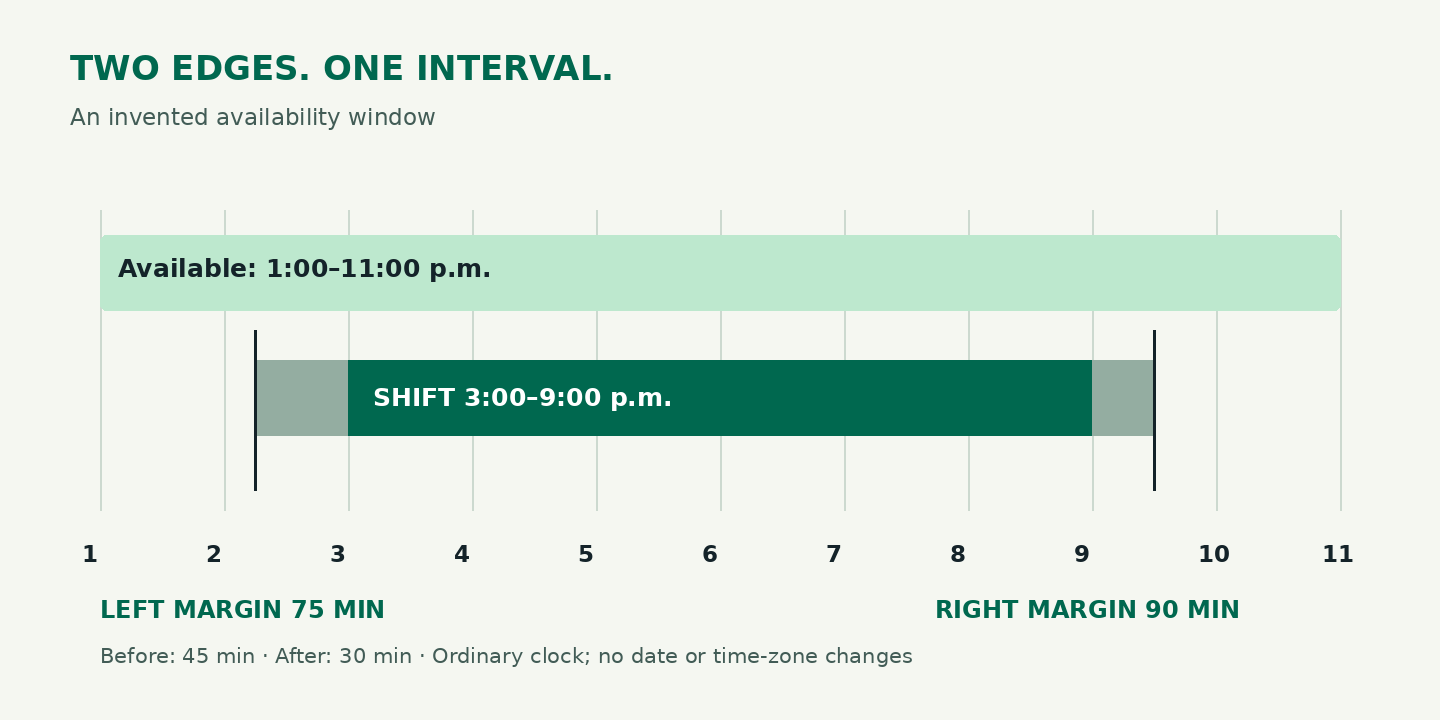
Expand the work block before comparing it
Subtract the before-shift allowance from the proposed start to find the required departure. Add the shift duration and after-shift allowance to find the estimated return. “Before” can include travel and an assumed arrival buffer. “After” can include the assumed exit and return journey. Do not count the same allowance twice.
Then compare the expanded interval with the available interval. The required departure must be no earlier than the window’s beginning. The estimated return must be no later than its end. Looking only at the total hours misses a shift that is short enough but positioned badly.
Read each margin separately
- Left margin
- The time from the earliest available departure to the required departure. A negative value means you would need to leave before your own boundary permits.
- Right margin
- The time from the estimated return to the latest available return. A negative value means the plan runs past your own ending boundary.
- Exact fit
- Zero on an edge is a mathematical fit with no allowance left on that side. It is not evidence of reliability, comfort or readiness.
Do not add the margins together and use the sum to erase a conflict. Ninety minutes after a shift cannot repair a departure that needs to happen thirty minutes too early. The edges answer separate questions.
Try a change that looks harmless
Use the number for the decision it supports
The shift-window planner reproduces this arithmetic for hypothetical values. It does not calculate earnings, approve availability, evaluate fatigue or account for time-zone or daylight-saving changes. A result is a prompt to examine the assumptions, not permission to proceed.
If the interval is tight, try two stress tests. If it crosses midnight, read the date-boundary example before entering it.
Evidence and limits
Public-source review: October 16, 2026. The planning method and invented examples are editorial analysis, not employer rules. This article does not establish eligibility, approval, pay, required rest or a personal schedule.